
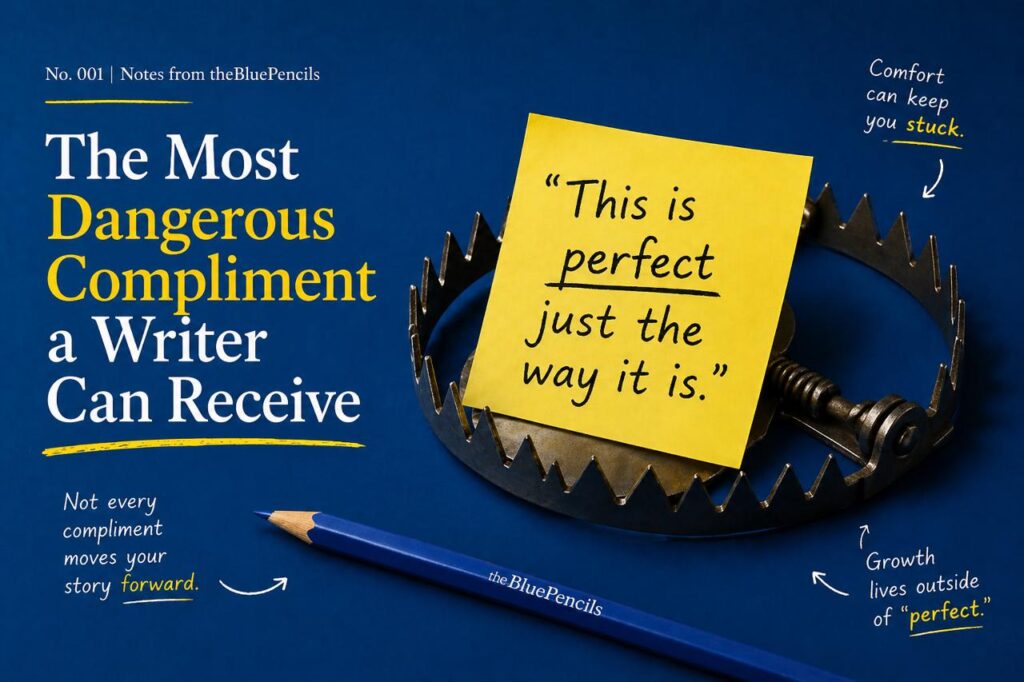
Let me tell you about the moment a writer’s book dies.
It doesn’t happen at the rejection. It doesn’t happen in the silence after submission, or in the polite, impersonal email that explains nothing. It doesn’t happen at the desk, or in doubt, or in any of the dramatic moments writers tend to fear most.
It happens earlier. Much earlier. In a living room, usually. Or a coffee shop. Or over a phone call with someone who has just finished reading the manuscript and means absolutely everything they’re about to say.
“I loved it.”
“It’s really good.”
“Honestly—I think it’s ready.”
And the writer, who has spent months or years on this manuscript, who has doubted it and defended it and lost sleep over it, exhales. Finally. Someone who gets it. Someone who sees what they were trying to do.
What they don’t realise, in that moment of profound relief, is that those words—warmly meant, genuinely felt, delivered with complete sincerity—may be the most damaging thing anyone says to them in the entire writing process.
I want to be careful here, because I am not talking about dishonesty. I am not talking about people who read carelessly, praise lazily, or tell a writer what they want to hear out of conflict avoidance. I’ve met those people, too, and they’re a separate problem.
I’m talking about the good ones. The careful readers. The friends who stayed up late to finish it.
The writing group members who engaged seriously, who came back with specific observations, who clearly thought about what they read.
I’m talking about the feedback that feels, in every possible way, like exactly what it appears to be—generous, considered, and trustworthy.
And I’m telling you that this feedback, from these people, given in this spirit, can quietly destroy
a manuscript’s chances in ways that are genuinely hard to recover from.
Here is why.
Enjoyment is not criticism. And for a writer, the difference is everything.
When someone reads your manuscript and enjoys it—truly enjoys it, loses themselves in it, finishes it with genuine feeling—something important has happened. Something worth knowing. You have written something that works on a human level. That connects. That earns a reader’s time and returns it with interest.
That is not ‘nothing’. Please don’t misread what I’m saying. That is, in fact, the foundation of everything.