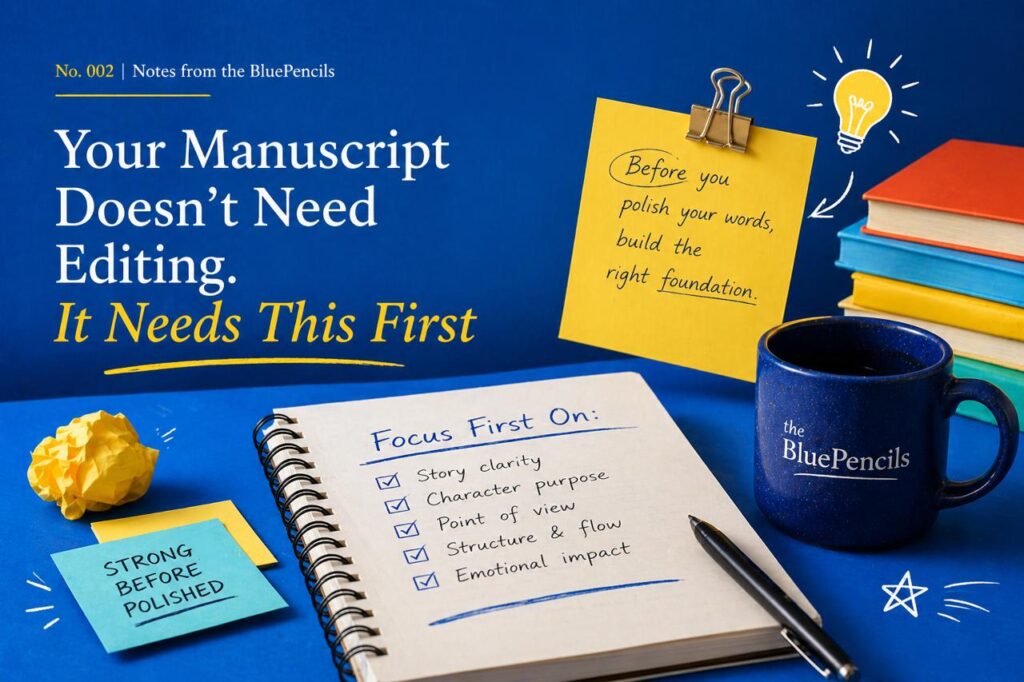
No. 002 | Notes from the BluePencils
Your Manuscript Doesn’t Need Editing. It Needs This First
I’ve said this to writers who weren’t ready to hear it. I’ll say it here, plainly, because I think it’s one of the most useful things anyone in this industry can tell you:
Sending your manuscript to an editor before it’s ready is not just premature; it’s expensive, often disappointing, and in some cases, genuinely damaging to a book that deserved better.
I say this as an editor.
Here’s what I’ve watched happen, more times than I’d like to count. A writer finishes a manuscript. The relief of finishing is enormous—months, sometimes years of work, finally done. The excitement is real. The desire to move forward is completely understandable. So they send it out. To a publisher, an agent, or an editor. Sometimes all three.
And the responses that come back—rejection, or feedback that feels overwhelming, or an editorial report that identifies problems so fundamental they require starting significant sections again—land like a blow. Not just to the manuscript. To the writer’s confidence. To their belief in the work, in themselves, in whether any of this was worth the effort.
What went wrong?
Almost always, the same thing. The manuscript went out before the writer had finished their job. Before the work that belongs specifically and irreplaceably to the writer—the work no editor can do for them—had been done. There is a stage of the process that belongs to you alone.
An editor can do extraordinary things for a manuscript. Shape it, sharpen it, find what’s buried in it, and bring it forward. A good editor can be the difference between a good book and a great one, between a manuscript that almost works and one that fully does.
But an editor cannot do your seeing for you.
They cannot feel, from the inside, whether the emotional arc of your story is true. They cannot know whether the character whose motivation feels slightly thin on the page was fully realised in your mind and simply didn’t make it through to the writing. They cannot tell you whether the ending you’ve written is the ending you actually meant—or the ending you settled for because you were tired and ready to be finished.
Only you can know those things. And the manuscript needs you to know them—clearly, honestly, without the fog of proximity that comes from having lived inside the work for too long—before it’s ready for anyone else.
So what does it need first?
Distance. Real distance.
Put the manuscript away. Two weeks at minimum—a month if you can bear it. This is not wasted time. This is the most important thing you can do for your own work. The writer who returns to a manuscript after a genuine distance reads it differently. They catch what the excited, relieved, ready-to-be-done writer missed. They feel where the story sags, where the voice shifts, where a scene that felt powerful in the writing lands quietly on the page.
You cannot get that clarity without the distance. There are no shortcuts here.
Before anyone else touches it—read it. The whole thing. In as few sittings as possible, so you experience it the way a reader would rather than the way a writer does. Don’t edit as you go. Don’t tinker. Just read, and pay attention to what you feel. Where does your attention drift? Where do you feel slightly relieved to have moved past a section? Where does something not quite land the way you intended?
Those moments are your manuscript telling you where it still needs your attention. Listen to them.
Beta readers. The right ones, not the people who love you. Not the people who want you to feel good about what you’ve made. The people who will read it as readers—honestly, critically, without the protective instinct that comes from caring about the writer.
Two or three good beta readers will show you things about your manuscript that will genuinely surprise you. Things that are working better than you thought. Things that aren’t working at all. The gap between what you intended and what arrived on the page—which is almost always larger than you expect, and which no amount of rereading your own work will reveal.
Go back in with everything you now know. Fix the holes. Cut the scenes you love, but that serve nothing—yes, those ones, the ones you’ve been quietly protecting. Tighten what drags. Strengthen what matters. This is your manuscript. This work belongs to you, and it cannot be delegated.
A manuscript that has been through this process is a fundamentally different thing to work with. Tighter, cleaner, more itself. And here is what nobody tells writers about this: a well-prepared manuscript doesn’t just edit better. It costs less, takes less time, and achieves significantly stronger results. Because the editor can go deeper—past the surface problems that would otherwise absorb their attention—into the work that actually elevates a manuscript from competent to compelling.
Everyone wins. Most importantly, the book wins.
The writers who make it aren’t always the most talented ones in the room. I’ve worked with extraordinarily gifted writers whose manuscripts never found their readers—because they moved too fast, skipped preparation, and sent the work out before they’d done everything it needed of them.
And I’ve worked with writers of more modest natural ability whose books found devoted audiences—because they were willing to do the slow, unglamorous, deeply necessary work of preparation. Because they understood that finishing a draft is not the same as finishing a book. Because they respected the process enough to see it through completely, even when completing it was harder and slower than they’d anticipated.
The manuscript you’ve written deserves that respect. The readers who will one day love it deserve it too.
Don’t shortchange either of them by moving before you’re ready.
At theBluePencils, every conversation begins here—with an honest assessment of where your manuscript actually is, and what it genuinely needs before anything else. If you’re not sure whether your manuscript is ready, that question alone is worth bringing to us.
[https://thebluepencils.com/contact/]
theBluePencils—Story. Structure. Soul.
*