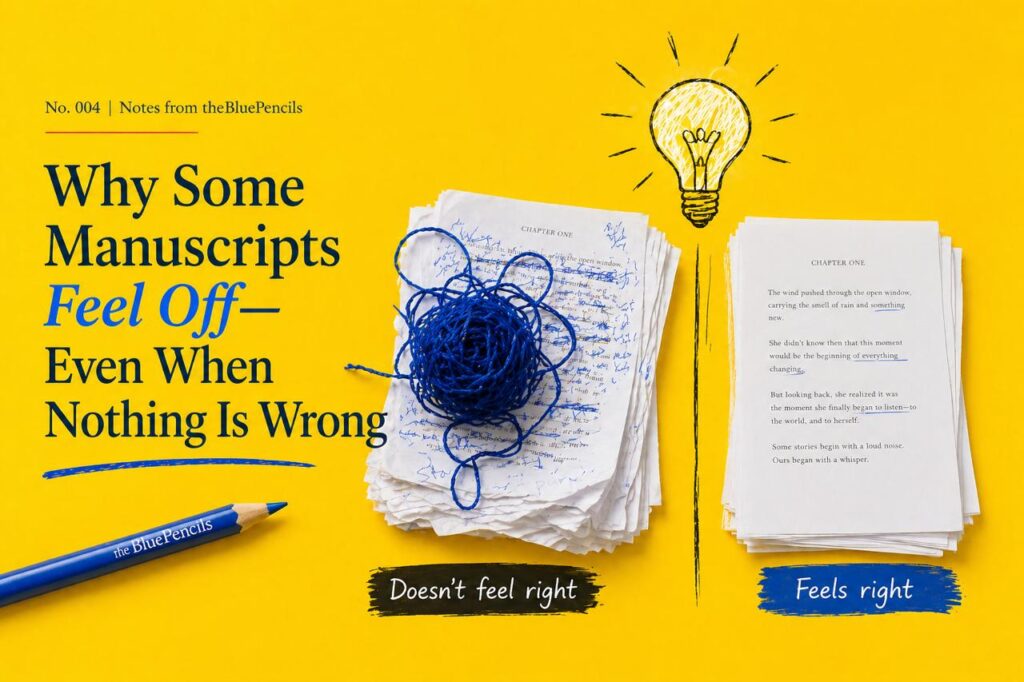
There’s a particular kind of manuscript that stays with you—not because it’s exceptional, and not because it’s broken. But because something about it won’t quite settle.
The language is clean. The structure holds. The story moves. You read it looking for the problem, and you don’t find one—not a clear one, not anything you can immediately circle and explain. And yet something keeps pulling at you, quiet and persistent.
It feels off.
I’ve encountered this more times than I can count, and early in my career, it genuinely troubled me. I’d finish a manuscript, set it down, and sit with this vague dissatisfaction I couldn’t justify. Nothing was wrong. So why didn’t it feel right?
It took time—and a lot of manuscripts—to understand what I was actually sensing.
Correctness and cohesion are not the same thing.
A manuscript can be technically sound in every measurable way and still lack the one quality that makes writing feel alive—alignment. A consistent, clear sense of how this particular story wants to be told. Not just what happens, but how it is meant to be experienced.
And when that alignment breaks down, even slightly, the reader feels it. They may not stop reading. They may not even know why their attention is drifting. But something between them and the story has quietly loosened.
I remember working on a manuscript—a literary novel, genuinely well written—where I kept losing the thread somewhere around the middle chapters. The prose was beautiful. The plot was sound. But the voice, I eventually realised, was doing something strange. In moments of intense emotion, it pulled back and became almost clinical. In quieter, transitional scenes, it leaned in close and became almost breathlessly intimate. The two registers weren’t wrong individually. But they were reversed. The manuscript was emotionally distant precisely where it needed to hold you, and overwhelming precisely where you needed space to breathe.
The writer hadn’t noticed. They were too close to it. Each choice had felt right in the moment it was made.
Together, those choices were creating distance neither of us had intended.
What “off” usually means
In my experience, when a manuscript feels off without an obvious reason, it’s almost always one of three things—sometimes all three at once.
The voice shifts without intention. Not because the writer lacks a voice, but because they wrote across months or years, in different moods, at different stages of understanding their own story. The manuscript carries all of those versions of the writer simultaneously, and they don’t always agree with each other.
The tone doesn’t match the emotional weight of the scene. A moment that should devastate the reader is written with the same measured pace as a scene of ordinary dialogue. A quiet, tender exchange is given the same urgency as a crisis. The writing is accurate but not calibrated.
The pacing moves forward without carrying the reader with it. Events happen in the right order. The plot progresses. But there’s no breath in it—no variation in rhythm, no sense that the story knows when to slow down and let something land. The reader arrives at important moments without having been properly brought there.
Individually, each of these is a small thing. Together, they create a manuscript that functions but doesn’t resonate. That is read but not felt.
What fixing it actually looks like
The instinct, when something feels off, is to add more description, more interiority, more explanation. But that almost never helps. Usually, it makes things worse because you’re adding weight to a structure that needs realignment rather than more material.
What it actually requires is stepping back far enough to hear the manuscript as a whole. To ask not what is wrong with this sentence but what this manuscript is trying to feel like—and then to read every choice against that answer. The rhythm of a sentence. The level of detail in a scene. The emotional register of a particular moment. When these begin pulling in different directions, the manuscript loses its centre. And a manuscript without a centre cannot hold a reader, no matter how well individual parts are written.
This is some of the most demanding editorial work there is. Not because it requires the most technical knowledge, but because it requires the most sensitivity—the ability to hear something that isn’t wrong but isn’t right either, and to understand what it needs to become.
This is work I find genuinely absorbing. The manuscripts that fall off are often the ones closest to being something exceptional—they just haven’t found their centre yet.
At the BluePencils, this is the kind of reading we do. Not just looking for what’s broken, but listening for what’s missing. Staying with a manuscript until it becomes what it was always trying to be.
If your manuscript feels close but not quite there—and you can’t put your finger on why—that’s exactly the kind of conversation we’d like to have.
[contact us]
theBluePencils—Story. Structure. Soul.