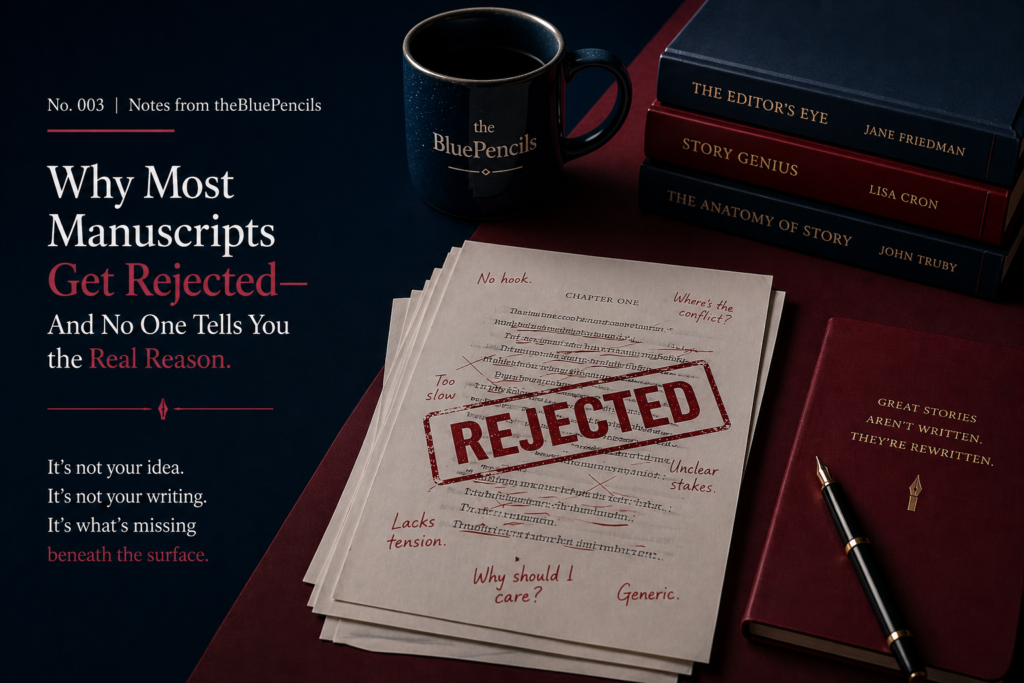
You’ve finished your manuscript. You’ve revised it more times than you can count. Maybe you’ve even had it edited. You send it out—to publishers, agents, competitions—and then you wait. But what comes back is silence. Or worse, a polite standard rejection that tells you absolutely nothing. And you’re left sitting there with the same question every writer eventually asks:
What went wrong?
The answers you’ll find online are predictable. Weak plot. Flat characters. Poor grammar. And yes, sometimes it’s one of those things. But in my experience—after years of working with manuscripts at every stage, from rough first drafts to competition entries—those are rarely the real reason. The real reason is harder to hear.
Most manuscripts aren’t rejected because they’re badly written. They’re rejected because they’re not ready. And the writer, almost always, genuinely believed they were.
The First Five Pages Problem
Here’s something publishing professionals will tell you plainly: editors and agents do not read your entire manuscript before forming an opinion. They can’t—the volume of submissions makes that impossible. What they have instead is instinct, sharpened by years of reading, and that instinct is triggered fast.
If your opening pages don’t establish a clear voice, a sense of control over the language, and a feeling that this writer knows where they’re going, the manuscript is quietly set aside. Not because it’s terrible. Because it doesn’t feel assured. And in a pile of two hundred submissions, assured is what gets read.
Writers often say their story picks up in chapter two, or that the real momentum begins around page thirty. I understand why—sometimes that’s genuinely where the heart of the book lives. But a reader, an agent, an editor—none of them will get to chapter two on faith alone. The opening pages are not just an introduction. They are your argument for why this book deserves someone’s time.
If that argument isn’t made clearly and confidently from the start, the rest of the manuscript rarely gets the chance to speak.
The Illusion of Depth
This one is delicate, and I say it with great respect for the writers I’ve seen fall into it—because it comes from genuine feeling, genuine effort.
Many manuscripts sound deep. They carry heavy emotions, dramatic situations, and characters in crisis. The writing is earnest, and the intention is real. But depth isn’t created by intensity. It’s created by precision.
A character weeping on the page is not automatically moving. A character whose silence in a particular moment reveals everything—that’s closer to what depth actually feels like. The difference between the two is the difference between a writer describing emotion and a writer creating the conditions for a reader to feel it.
When a manuscript leans too heavily on telling the reader what to feel—through explanation, through internal monologue that goes on too long, through dramatic language doing the work that a quieter, sharper scene should be doing—it begins, paradoxically, to feel thin. The more it insists, the less it lands.
Editors recognise this immediately (we mark it as signposting). It’s one of the most common things I see, and one of the most fixable—but only when the writer can see it too.
Structure That Doesn’t Hold
A manuscript can have genuinely beautiful writing and still collapse under its own weight. I’ve seen it. It’s one of the more heartbreaking things to encounter as an editor—real talent, real care, and a structure that simply cannot carry the story.
It usually shows up in a familiar pattern: a strong, promising opening that gradually loses its sense of direction; a middle section that wanders, adding scenes that feel meaningful in isolation but don’t push anything forward; an ending that arrives either too quickly, as though the writer ran out of steam, or too slowly, as though they couldn’t bring themselves to let go.
Writers often sense when something isn’t holding together. They hope an editor will sort it out. And a good editor can do a great deal with structure—can identify where the problems are, suggest restructuring, and help find the spine of the story. But an editor cannot build a spine that isn’t there. If the fundamental architecture of the book hasn’t been thought through, no amount of line editing will make it stand.
Structure is the writer’s job. It has to be in place before the real editorial work can begin.
Writing for Yourself Without Realising It
This is the most common reason I see manuscripts fall short—and the most difficult to raise with a writer, because it touches something personal.
Many manuscripts are written from the writer rather than for the reader. The distinction sounds small. It isn’t.
Scenes exist because the writer loved writing them, not because they serve the story. Backstory is included in generous detail because it feels important to the writer—even when the reader doesn’t need it yet, or at all. Certain moments linger far longer than the narrative requires, because the writer is attached to them. A particular character gets more attention than the story needs because the writer finds them fascinating.
None of this comes from laziness or arrogance. It comes from love—the writer’s deep investment in their own world. But the reader isn’t inside your mind. They can only experience what the page gives them. And when a manuscript is written primarily to satisfy its creator, a reader feels that distance, even if they can’t name it. The experience turns inward rather than engaging. Something about it stays closed.
This is one of the hardest things to see in your own work. It almost always requires another pair of eyes.
The Almost There Trap
This is where most rejected manuscripts actually live (the second round, when the publisher invites the whole manuscript). They are not bad or broken. Just not finished in the way they need to be, and the gap between where they are and where they need to be is invisible to the person who wrote them.
This is the cruellest stage, because by this point, the writer has already done so much. They’ve already improved it significantly. They’re already deeply invested. So it genuinely feels ready. Every revision pass has made it better, so it’s surely good enough now.
But publishing doesn’t respond to effort. It responds to readiness. And those are not always the same thing.
What No One Tells You
Rejection almost never comes with an explanation. No detailed feedback, no roadmap, no indication of how close you were or what specifically fell short. Just a quiet, impersonal decision: not for us, or nothing at all.
So the writer is left to guess. And in the absence of clear information, most writers guess wrong—they assume the story wasn’t good enough, when often the story was fine. It was the execution, the preparation, the readiness that wasn’t there yet.
Where the Real Work Happens
A manuscript becomes publishable not in the first draft. Not even in the second or third. It becomes publishable in the stage most writers rush through or skip entirely—the stage of stepping back, reassessing the whole, questioning the structure with fresh eyes, tightening the intent of every scene, and asking honestly whether the reading experience on the page matches the vision in your head.
This is where clarity replaces assumption. This is where good writing becomes a good book. And this, more than anything, is where an editor can genuinely change the outcome—not by fixing what’s broken, but by helping you see what the manuscript still needs to become.
And This Is Where BluePencils Comes In
At the BluePencils, we don’t approach a manuscript as something to be corrected. We approach it as something to understand—where it is, where it’s trying to go, and what’s standing between the two.
Because a manuscript that has been properly assessed, honestly evaluated, and thoughtfully prepared doesn’t just read better. It stands a genuinely different chance.
If your manuscript has been rejected—or you’re preparing to send it out and something still doesn’t feel quite right—the question worth sitting with isn’t Is it good enough?
The better question is: is it truly ready?
If you’re not sure, that’s exactly what we’re here for.
[thebluepencils.com/contact/]
The BluePencils. Because every manuscript deserves more than a chance—it deserves clarity.
Let’s hear your story.