
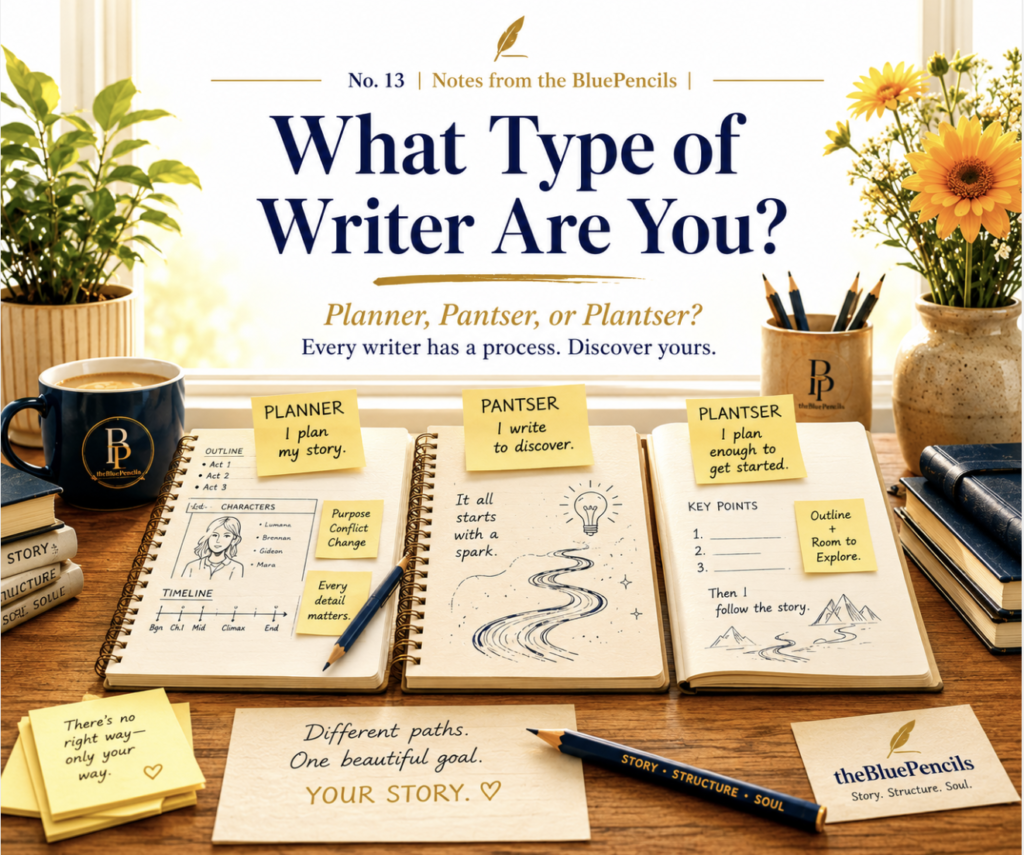
Before we talk about writing better, let’s talk about how you write.
Because not all writers arrive at a blank page the same way. Some come armed with colour-coded notebooks, character dossiers, timelines, maps, and chapter outlines so detailed that the story is practically written before the writing begins. Others sit down with nothing more than a sentence, an image, or a fleeting thought and trust the story to reveal itself as they go.
Neither approach is right. Neither approach is wrong.
But understanding which kind of writer you are can save you a great deal of frustration and help you work with your natural strengths rather than against them.
In over eighteen years of editing, I’ve worked with writers who couldn’t begin without a complete outline and writers who handed me a finished manuscript they’d written with absolutely no plan whatsoever. Both produced extraordinary work. What made the difference wasn’t their method—it was their understanding of it.
So, which one are you?
The Planner
You might also know this writer as the Architect, the Outliner, or the Plotter. Whatever the name, the Planner wants to know where the story is going before writing Chapter One. For some, the drafting phase doesn’t truly begin until detailed outlines, chapter summaries, character profiles, world-building notes, timelines, and scene cards are already in place. The actual writing, when it comes, is simply the execution of a carefully designed blueprint.
If you’re a Planner, you’ve probably said things like “If I don’t know the ending, how can I write the beginning?” or found yourself stopping mid-chapter to fix a timeline inconsistency before you could continue. You need the architecture to be sound before you move in.
The strengths are real, strong structure, fewer plot holes, consistent pacing, and better foreshadowing. But the challenges are equally real. Planners can become so absorbed in planning that they struggle to get started. Sometimes the story, having been so carefully controlled, loses the ability to surprise even its own author.
Planners often spend months building the house. Then they move in.
The Pantser
The name comes from the phrase writing by the seat of your pants—and it suits. The Pantser begins with curiosity rather than certainty. Maybe it’s a character. Maybe a single image, a line of dialogue, a question that won’t leave them alone. And that’s enough. They open the document and begin.
The Pantser writes to discover what happens next. They often have no idea where the story is heading. Sometimes neither do their characters. If you recognise yourself here, you’ve probably sat back from a scene you’ve just written and thought, ‘I didn’t know she was going to do that’, and then, ‘Wait… that actually works.’
The strengths are considerable—natural surprises, organic character development, genuine creative freedom, and a sense of discovery that keeps the writing alive on every page. The challenges are equally considerable—plot holes, dead ends, major rewrites, and structural issues that only reveal themselves once the whole draft exists.
The Pantser finds and builds the road while driving on it. It’s exhilarating. It’s also occasionally terrifying.
The Plantser
Perhaps the most common writer working today. The Plantser is, as the name suggests, a blend of Planner and Pantser, someone who starts with enough structure to feel oriented but leaves enough room for the story to breathe and surprise them.
The outline exists. The major plot points are mapped. The key characters are known. The rough shape of the ending is visible on the horizon. But the Plantser doesn’t need every scene card filled before they begin, and they’re comfortable letting the story take a detour if something more interesting presents itself along the way.
I know where I’m going, the Plantser thinks. I just don’t know exactly how I’ll get there.
If the Planner builds a railway and the Pantser explores the wilderness, the Plantser carries a map and occasionally takes the scenic route.
The Discovery Writer
A close cousin of the Pantser, but distinct in one important way. The Discovery Writer isn’t merely improvising; they’re using the act of writing itself as a way of understanding what the story actually is. Many of the finest literary novelists fall into this category.
They often begin not with a plot or even a character, but with a theme, an emotion, a question they’re trying to answer and can’t quite reach any other way. The plot emerges later—sometimes much later. The typical Discovery Writer thought isn’t ‘Where is this going?’ but what is this really about? and why does this character matter to me?
Their first drafts can look bewildering from the outside. But they know something the other types sometimes forget—that you cannot always plan your way to the truth of a story. Sometimes you have to write your way there.
The Rewriter
Some writers don’t truly begin until the second draft. The first draft exists only to create the raw material—messy, incomplete, sometimes barely coherent—from which the real book will eventually be made. These writers can appear chaotic during the drafting phase, but they often produce remarkably polished manuscripts because revision is genuinely where they thrive.
The first draft is permission, the Rewriter tells themselves. I’ll fix it later.
And they usually do.
The truth nobody really talks about
Most writers are not one type. They are a mixture—and that mixture shifts depending on the project, the deadline, the mood, and the stage of the work. You might be a Planner for novels and a Pantser for short stories. A Discovery Writer when you’re stuck and a Rewriter when the deadline has disappeared. A Plantser on a good day and a full Pantser on a great one.
Writing methods aren’t identities. They’re tools. The best writers learn when to reach for each one.
So ask yourself honestly—when an idea strikes, what do you actually do first?
Do you open a notebook and start outlining? Open a document and start writing immediately? Jot down a few notes and then begin? Or do you sit with it for weeks, turning it over quietly in your mind before committing a single sentence to the page?
Your answer probably reveals more about your creative process than any writing guide ever will.
And here’s what I want you to take from this—every single one of these approaches has produced remarkable books. The goal isn’t to become someone else’s kind of writer. It’s to understand the kind of writer you already are. Because once you stop fighting your own process, the work becomes a little less mysterious.
And a lot more enjoyable.
At theBluePencils
Over the years we’ve worked with meticulous planners, fearless pantsers, determined plantsers, and writers who couldn’t explain their process if they tried—and wouldn’t have wanted to. The method always varies. The goal never does—a manuscript that tells its story as clearly, honestly, and powerfully as it can.
After all, there are many ways to write a book.
There’s only one way to finish one.
theBluePencils
Story. Structure. Soul.