
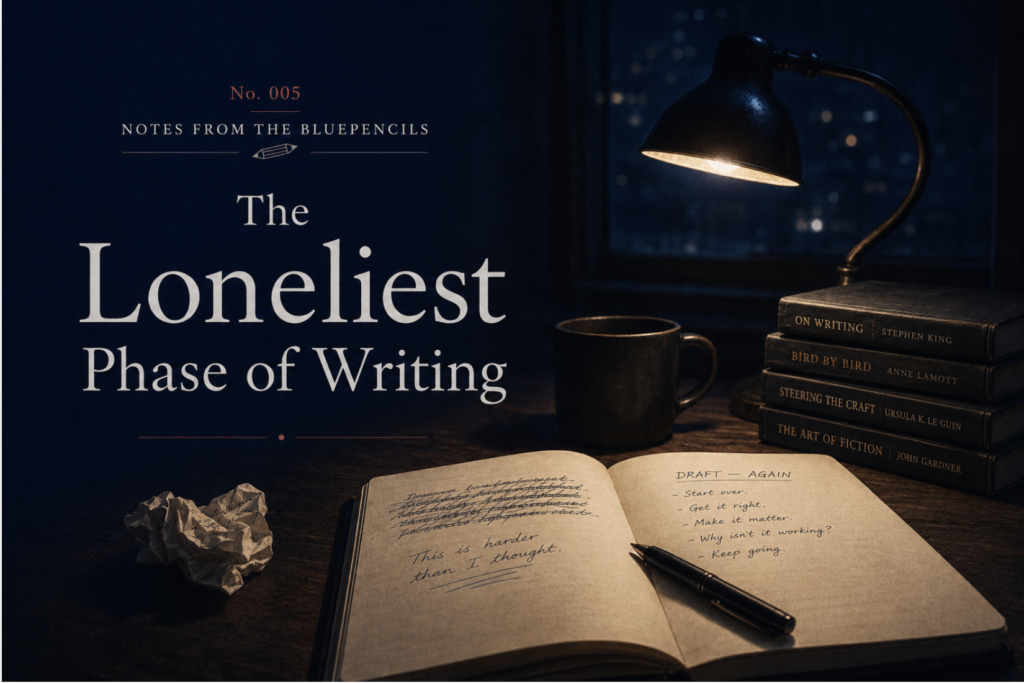
You start with energy. An idea that won’t leave you alone. A voice that feels urgent, almost impatient. Pages that come faster than you expected. You think—this might actually work.
And for a while, it does. You write in bursts. You talk about it, maybe carefully, the way you talk about something you don’t want to jinx. You imagine the finished book, the cover, the moment someone you respect tells you it’s extraordinary. That part is easy to fall in love with. The beginning always is.
Then something changes. The writing slows. Not because you’ve run out of ideas—but because the ones you have aren’t as clear anymore. The path ahead, which once felt obvious, has quietly become less so. The excitement that carried you through the first stretch begins to thin out, and without it, the work feels different.
This is the phase no one really talks about. The long, unremarkable middle—the stretch where the work stops feeling like an adventure and starts feeling like a commitment you’re no longer sure you’re equal to.
No one is waiting for these pages. No one is asking how it’s going. There’s no visible progress you can point to, no milestone that feels worth celebrating. Just you, returning to a desk and a document that suddenly asks more of you than it did before. This is where most writers stop.
Not because they lack discipline. Not because the idea wasn’t good enough or the talent wasn’t there. But because this phase doesn’t match the version of writing they carried in their heads. The version where inspiration shows up reliably. Where the words flow because the story is alive. Where it feels, at least most of the time, like it’s working.
The middle doesn’t feel like that. The middle feels like uncertainty dressed up as work.
So they step away. Temporarily, at first—a few days to reset, to come back fresh. Then the days become weeks. The manuscript stays open in a folder somewhere, neither abandoned nor progressed. And eventually the distance grows too large to comfortably cross, and the book that might have been something quietly becomes one of those ideas the writer still mentions occasionally, in the past tense, with a particular kind of resignation.
I’ve seen this happen to writers with real talent. Writers whose opening chapters I’ve read and thought—this one has it. The voice was there. The idea was strong. But they couldn’t get through the middle, and the middle is where the book actually lives.
But here’s what happens if you stay. You stop chasing momentum and start building it—slowly, unglamorously, one session at a time. You rely less on inspiration and more on habit. You begin to develop a different relationship with the work—not the breathless excitement of the beginning, but something steadier. More honest. You start to see your manuscript not just as what it is, but as what it isn’t yet. And that shift in perception, uncomfortable as it is, is exactly what the work needs from you.
Doubt arrives in this phase, too. It’s practically guaranteed.
It starts quietly—a small voice asking whether a particular scene is working, whether a character’s motivation is clear. Manageable. Easy to dismiss. Then it gets louder.
Is this working at all? Does this story actually have something to say? Have I overestimated this idea from the beginning? Am I the writer I thought I was when I started this?
Most writers treat this doubt as a warning sign. Evidence that something has gone wrong, that the project is in trouble, that they should perhaps step back and reconsider.
But in my experience—and I’ve sat with enough manuscripts to have some—that doubt is often the most productive thing that happens in the entire writing process. Because for the first time, you’re not just inside the writing. You’re looking at it. Questioning it. Testing it against what it’s trying to be. The discomfort isn’t the work breaking down. It’s the work becoming clearer. It’s you becoming a more honest judge of what you’ve made.
The beginning can’t give you that. The beginning is too much in love with itself.
The middle does something quietly extraordinary. It forces you to continue without excitement, without momentum, without the feeling that it’s going well—and in doing so, it makes you a different kind of writer than you were when you started.
This is where the shift happens. From someone who began writing a book to someone who is actually writing one. From someone who had an idea to someone who is doing the work that ideas require.
Most manuscripts don’t fail at the end. They fail here—in this stretch where nothing feels certain, where the progress is slow and invisible, where the only thing keeping the book alive is the daily decision to return to it. Not because you feel like it. Because you said you would.
There’s no shortcut through it. Nothing that makes it feel easier than it is. But there is something on the other side of it that the beginning never offers—a quiet certainty. The knowledge that you didn’t stop when stopping would have been the easier choice.
If you’re in this phase right now—if the work feels heavier, slower, and less obvious than it did when you started—it doesn’t mean something has gone wrong.
It means you’ve moved past the surface of it. Past the part that runs on excitement and into the part that runs on something deeper. Something more durable.
And that is where the real writing begins.
The writers we eventually read aren’t always the most gifted ones in the room. They’re almost always the ones who didn’t walk away when the process stopped feeling easy. Who kept showing up to the desk even when the desk had nothing encouraging to offer. Who trusted, on no particular evidence, that the work was worth finishing.
At the BluePencils, we work with manuscripts at every stage. But the ones that stay with us—the ones that go on to become something lasting—almost always have this in common: they were written by someone who didn’t leave when it got hard.
If you’re still in it, still showing up, still fighting your way through the middle—we’d love to see what you’re building. Because a manuscript that has been carried this far deserves every chance to become what it set out to be.
[www.thebluepencils.com/contact/]
BluePencils. Because every great book begins with someone who refused to stop.